
How Accurate Does Baby Feeding Tracking Need to Be?
Many parents start tracking baby feeds to feel more confident about how much and how often their baby is eating. Over time, a common question comes up: How accurate does feeding tracking really need to be?
It is easy to worry about missing entries, forgetting exact times, or not logging every feed perfectly. The reassuring news is that feeding tracking does not need to be precise down to the minute to be useful. What matters most is understanding patterns over time, not creating a flawless record.
This article explains how healthcare providers actually use feeding information, what level of accuracy is helpful, and how to keep tracking supportive rather than stressful.

Why Parents Track Feeding in the First Place
Most parents track feeds because feeding can feel unpredictable in the early weeks. Babies may eat frequently, cluster feed, or change routines suddenly, which makes it hard to know what is normal.
Tracking can help parents:
- Notice how often feeds happen across the day and night
- See whether feeding frequency is increasing as babies grow
- Connect feeding patterns with diaper output and sleep
- Share clearer information with caregivers or healthcare professionals
In most cases, tracking is about reassurance and awareness, not perfection.
Why Perfect Accuracy Is Not Required
It is common to assume feeding logs need to be exact to be meaningful. In practice, healthcare providers rarely expect or rely on perfectly timed records.
Pediatric guidance focuses on trends rather than individual data points. For example, newborns often feed 8 to 12 times or more in a 24-hour period, especially in the early weeks, and that frequency can vary from day to day without indicating a problem (Source: CDC).
Missing the precise start or end time of a feed does not change the overall picture if feeding is happening regularly and other indicators remain reassuring.
What Information Matters Most
Feeding Frequency Over Time
How often your baby feeds across a full day is usually more informative than the exact timing of each feed. Patterns such as regular feeding throughout the day and night or temporary increases during growth spurts provide meaningful context.
Seeing that feeds are happening consistently is usually more useful than knowing whether a feed started at 2:05 or 2:15 a.m.
For expectations around timing and frequency, see our article on Newborn Feeding Schedules.
Diaper Output as Context
Feeding logs are most helpful when viewed alongside diaper output. Wet diapers offer a practical, observable sign that intake and hydration are adequate.
Pediatric guidance consistently uses diaper output as part of feeding assessment, especially in young babies. Once feeding is established, steady wet diaper counts are one of the clearest reassuring signs (Source: Nationwide Children's Hospital).
This relationship between feeding and output is explored further in How to Track Newborn Diaper Changes.
Changes That Persist Over Several Days
One of the biggest benefits of tracking is noticing changes that last more than a day or two. A single off day can happen for many reasons, such as longer sleep stretches, minor illness, or routine disruptions.
Tracking becomes valuable when it highlights:
- A consistent increase or decrease in feeding frequency
- Ongoing feeding refusal or noticeably shorter feeds
- Repeating patterns across several days
These longer-term trends are what healthcare providers focus on when assessing feeding.
How Imperfect Tracking Can Still Be Helpful
Even when tracking is incomplete, it can still offer useful insight. Many parents forget to log overnight feeds, miss entries during busy days, or estimate timing instead of recording it exactly.
Imperfect tracking can still:
- Confirm that your baby is feeding often enough overall
- Show when feeding increases during cluster feeding or growth spurts
- Highlight differences between daytime and nighttime feeding
- Support clearer conversations with healthcare professionals
For example, noticing that your baby feeds more frequently in the late afternoon or that overnight feeds remain consistent provides helpful context, even without exact timestamps.
When Tracking Might Create Stress
Tracking is meant to support parents, not add extra pressure. For some families, tracking becomes less helpful if it starts to feel like a rigid checklist.
Tracking may create stress if it:
- Increases anxiety about missing or incorrect entries
- Leads to second-guessing normal baby behavior
- Makes feeding feel like a task rather than a natural connection
If this happens, simplifying your approach can help. Focusing on general patterns, such as "frequent feeds today" or "similar to yesterday," is often enough for many parents.
How Healthcare Providers Use Feeding Logs
Healthcare providers do not expect perfect logs. Instead, they use feeding records as one piece of a broader picture.
When reviewing feeding information, providers typically consider:
- Regular feeding across the day and night
- Diaper output patterns
- Weight gain over time
- Changes compared to previous weeks
Feeding logs support these conversations, but they are not evaluated in isolation.
When More Detail May Be Helpful
There are situations where slightly more detailed tracking can be useful, such as:
- Concerns about weight gain
- Ongoing feeding challenges
- Medical conditions affecting feeding
- Guidance from a lactation consultant or pediatrician
Even in these cases, the goal is clarity, not perfect precision.
Takeaway
Feeding tracking does not need to be exact to be valuable. What matters most is identifying patterns over time, not recording every feed perfectly.
If tracking helps you feel more confident and informed, it is doing its job. If it becomes stressful, stepping back or simplifying can be just as supportive. Feeding logs are tools to help you understand your baby, not measures of how well you are doing.
The information in this article is based on established pediatric guidance and reputable health sources and is provided for general education. It should not replace advice from a qualified healthcare professional.
Frequently Asked Questions
Is it okay if I miss a feed when tracking?
Is it okay if I miss a feed when tracking?
Yes. Missing occasional entries is common, especially during busy or exhausting days. Trends across several days, such as how often your baby feeds overall, are far more useful than complete accuracy on any single day.
Do I need exact times for every feed?
Do I need exact times for every feed?
No. General timing and frequency are usually sufficient unless you have been advised otherwise.
Should I track overnight feeds?
Should I track overnight feeds?
Noting that overnight feeds occur can be helpful, but exact times are rarely necessary.
Can I stop tracking once feeding feels stable?
Can I stop tracking once feeding feels stable?
Many families track more closely in the early weeks and then reduce tracking as feeding patterns become familiar. You can always return to tracking during periods of change, such as growth spurts or feeding challenges.
Will imperfect tracking still help my pediatrician?
Will imperfect tracking still help my pediatrician?
Yes. Healthcare providers focus on overall trends rather than minute-by-minute accuracy.
Track Feeding Patterns with Noora Baby
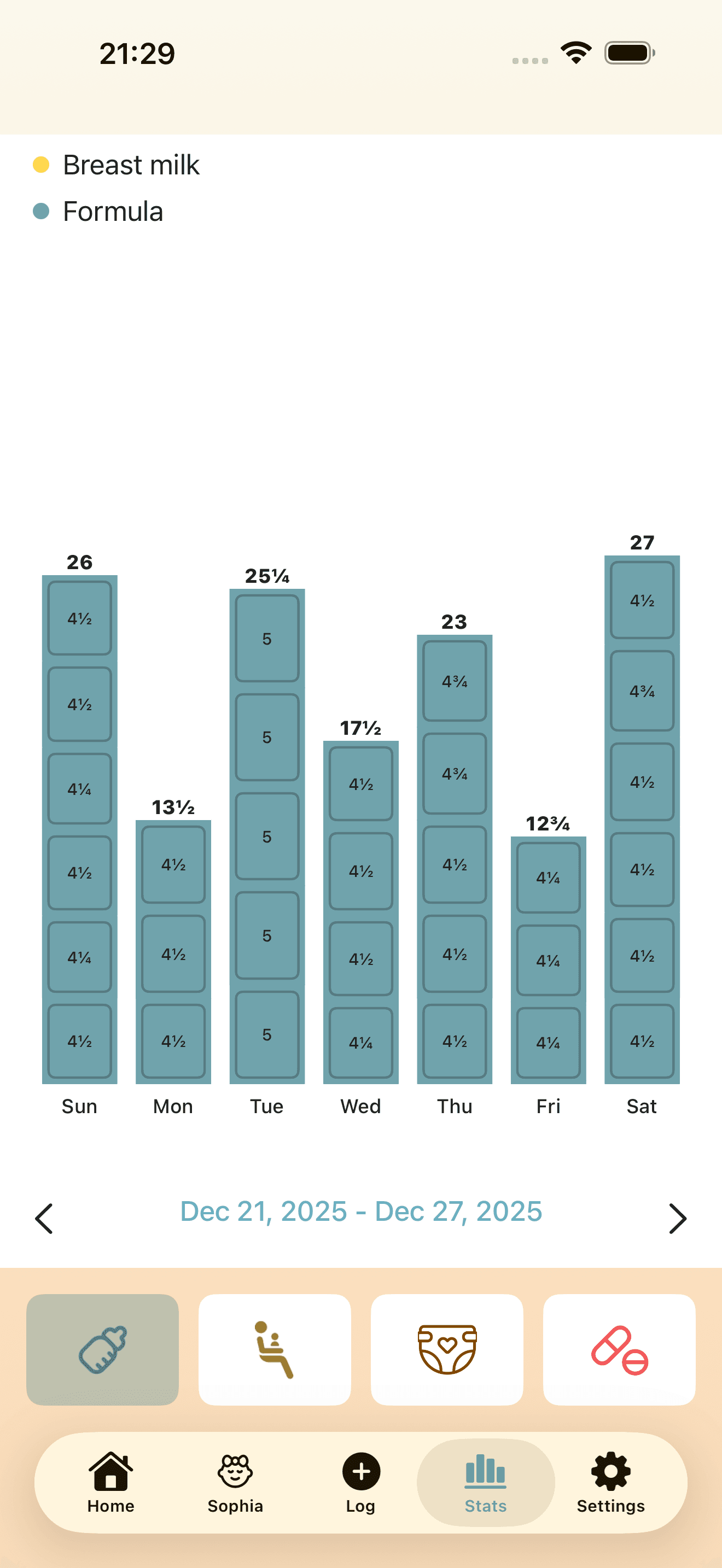
See your baby's feeding pattern emerge naturally with automatic tracking and pattern detection. No need to analyze the data yourself—Noora Baby shows you when baby typically gets hungry.
- One-tap start and stop for each session
- Side-tracking for breastfeeding (left/right)
- Ability to share logs with partners or caregivers

Related Guides
How to Tell If Your Baby Is Getting Enough Milk
Signs of adequate milk intake for breastfed and formula-fed babies
Newborn Feeding Schedule
How often should your baby eat by age
Track Breastfeeding
Best practices for breastfeeding tracking
Feeding Challenges and Tracking
Common feeding challenges and how tracking helps
Cluster Feeding Guide
When baby wants to feed constantly
All Feeding Guides
Back to feeding tracking hub
Start Tracking with Noora Baby
Monitor your baby's feeding patterns and have peace of mind knowing they're getting enough milk.